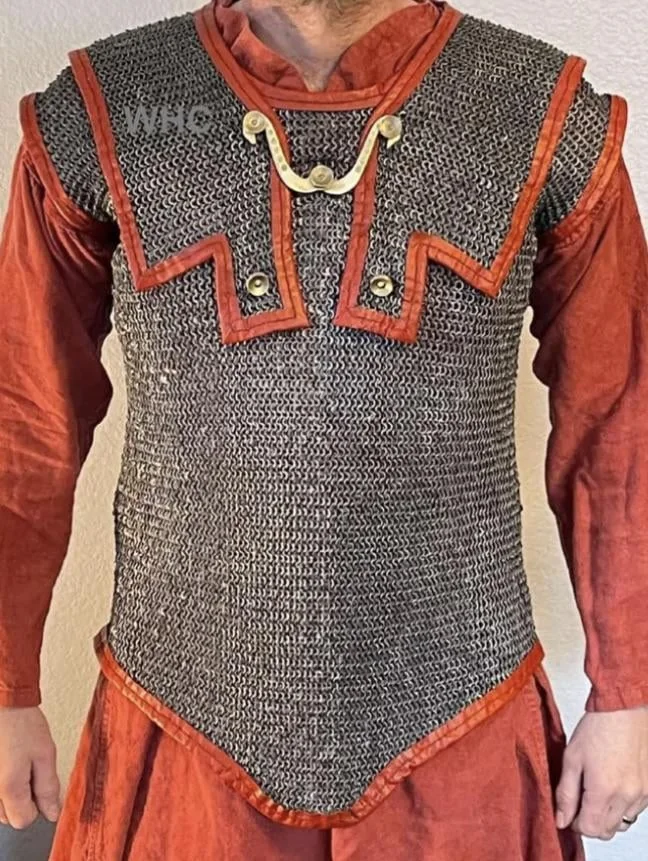
For more than six hundred years, mail was the universal Roman armor. Simple in concept, brutal to manufacture, flexible in use, repairable in the field, and effective against a wide range of weapons — lorica hamata did more military service than any other Roman armor type. Segmentata may be more iconic, but mail was what most legionaries actually wore.
Origins
Mail does not appear to have been a Roman invention. The earliest surviving mail comes from Iron Age Celtic graves in central Europe, dating to the 4th or 3rd century BC. Roman writers themselves credited the Gauls with the design. As Rome expanded northward through Italy and Gaul during the late Republic, mail came with — adopted first by Roman cavalry (often from defeated or allied Celtic warriors) and then by the legion's heavy infantry.
Construction
A mail shirt is built from tens of thousands of small iron rings, each interlocked with four others and individually riveted shut. The construction process: drawing iron wire, winding it around a mandrel, cutting it into individual rings, opening each ring, threading it through four neighbors, then heating it and riveting it closed with a small iron rivet. Each step required skilled hands. A single mail shirt represented hundreds of hours of expert labor.
The result was a flexible, breathable garment that hung from the shoulders to the hips and weighed between 20 and 33 pounds, depending on length and ring size. Roman manufacture achieved astonishing consistency — surviving fragments show extremely uniform ring sizes — which suggests the legion's fabricae were producing mail at industrial scale by the early imperial period.
- TypeMail armor (riveted)
- OriginCeltic, adopted by Rome
- In Servicec. 3rd C. BC – 5th C. AD
- Weight~20–33 lbs
- ConstructionTens of thousands of riveted iron rings
- CoverageTorso and shoulders, sometimes hips
- Primary UseUniversal Roman armor across all periods
Protection
Mail's protection profile is well-understood. Against cuts, it is excellent: a sword stroke against riveted mail almost never severs the rings. Against thrusts with sharp points (the gladius, the pilum's pyramidal head, narrow daggers), it is adequate but imperfect — a powerful thrust can drive the point of the rings apart and through. Against heavy blunt impact (a hammer, a club, a horse's hoof), it is much less effective: the rings do not absorb the blow, and the wearer can suffer broken bones beneath unbroken armor.
Romans understood these tradeoffs. They wore padded clothing — often leather or thick wool tunics — beneath their mail to absorb impact and prevent the rings from chafing. The combined system of padded clothing plus mail offered protection that was, for the period, very good against the weapons most commonly faced.
Service across the Empire
Mail was used by Roman troops from the late Republic through the fall of the Western Empire — over six hundred years of continuous service. It was worn by legionaries when segmentata was unavailable or unwanted; it was the standard for cavalry and auxiliaries; it remained in use through the 3rd-century reforms when segmentata disappeared; it was worn by late Roman armies and by the Byzantines who inherited their tradition. Few pieces of military equipment have ever served as long.
Legacy in medieval Europe
When the Western Empire fell, the mail-making tradition did not. Germanic kingdoms inherited Roman fabricae and Roman armorers, and mail continued to be made and worn through the early Middle Ages. By the 11th and 12th centuries, mail was the primary armor of Western European knights, and the Bayeux Tapestry shows scenes that would have been completely familiar to a Roman legionary of eight hundred years earlier. The hauberk of the medieval knight is, in technical and historical terms, the great-grandchild of the Roman lorica hamata.