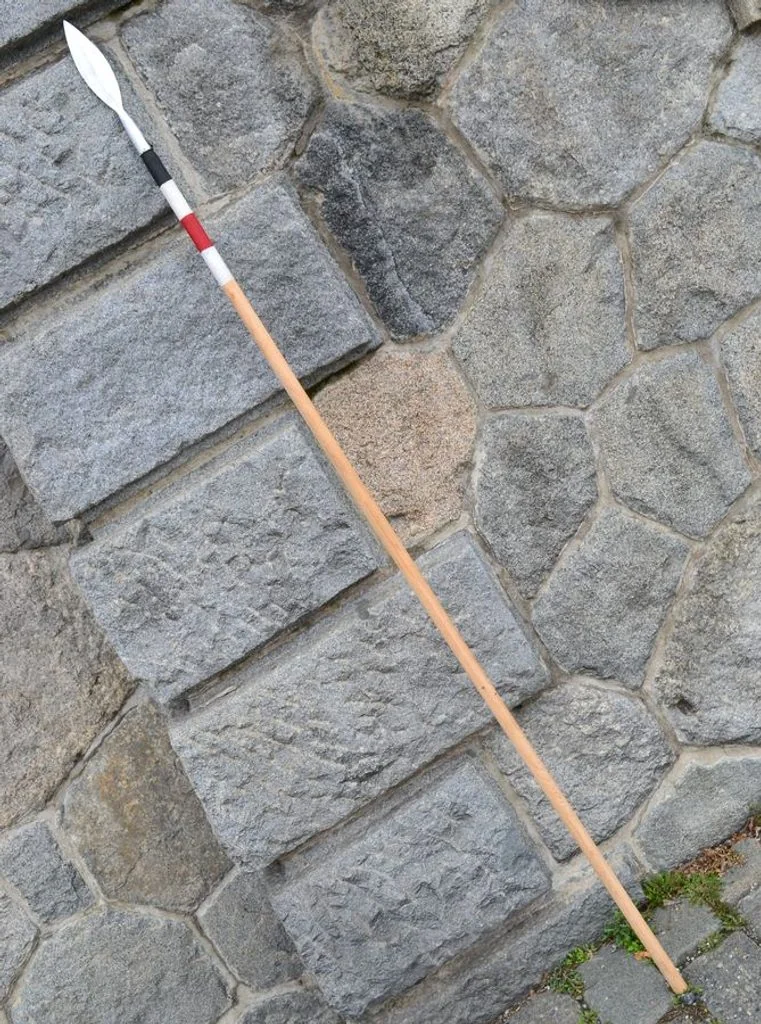
Before the pilum, before the legions had learned to throw, the Roman soldier carried a thrusting spear. The hasta was the older Roman weapon, inherited from Greek and Etruscan traditions, and it stayed in service in some form for nearly a millennium — long after the system that originally made it the legion's primary weapon had vanished.
The early Roman spear
In the early Republican army, the hasta was the standard infantry weapon of the heavy line. Six to seven feet long, with an iron head set on a wooden shaft, it was used in close formation by tightly packed ranks of armored men. The fighting style was inherited from the Greek phalanx — held overhand or underhand, the spears projected forward in a thicket, and the line advanced as a single body.
- TypeThrusting spear
- OriginItalic, with Greek and Etruscan influence
- In Servicec. 8th C. BC – 4th C. AD
- Total Length~6–7 ft
- Head MaterialIron (earlier bronze)
- Notable UsersTriarii (veteran reserve)
- Primary UseThrust from close formation
The hastati who switched
The Republican legion's front rank was originally called the hastati — the spear-bearers — because they fought with the hasta. By the late 4th and 3rd centuries BC, however, the hastati had switched to the pilum and gladius. The name remained, but the equipment had changed. By Marius's reforms in 107 BC, the hastati carried no spears at all. The word lingered as a kind of fossil, naming a unit by an older identity.
The triarii
Where the hasta survived longest in front-line service was with the triarii — the third line of the Republican legion, the veteran reservists held in reserve for emergencies. The triarii kept their hastae and fought in a tighter, more phalanx-like formation. The Latin phrase ad triarios redisse — "it has come to the triarii" — was Roman shorthand for a desperate situation, the kind of fight where the front lines had failed and the old men in the back row had to settle it with spears.
The Marian disappearance
When Marius reorganized the legion at the end of the 2nd century BC, the triarii distinction was abolished along with most of the old class-based divisions. Every legionary now carried roughly the same equipment — gladius, pugio, two pila — and the hasta disappeared from infantry use. By the early Empire, no Roman foot soldier carried the spear.
Cavalry and ceremonial use
The hasta survived in two contexts long after the infantry abandoned it. Roman cavalry continued to use spears (often called contus or lancea, but related in form) throughout the imperial period. And the hasta survived as a ceremonial object: presented to soldiers as awards (the hasta pura, an unbloodied spear, was a high decoration), carried by certain magistrates as symbols of office, and used in religious rituals. The thrusting spear had been the weapon of the citizen-soldier, and even when the army left it behind, the state kept it as a symbol.
Late Empire return
In the late Empire, as Roman tactics shifted again, infantry spears returned. The late Roman foot soldier might carry a spear (now usually called a spiculum or contus) along with his sword, fighting in formations that looked more like the old phalanx than the imperial legion. The form was different — different proportions, different head — but the function was the same. The hasta, in some sense, came back.