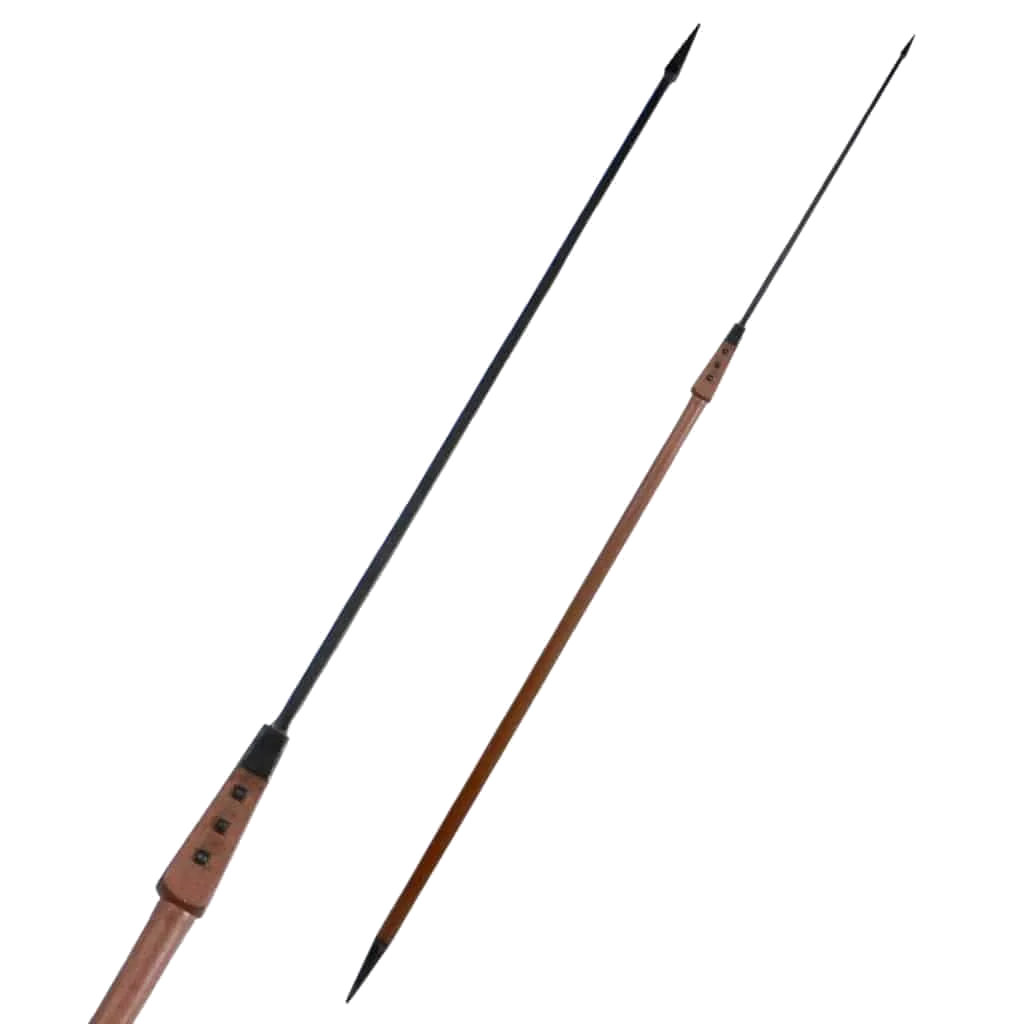
For nearly five centuries, every Roman legionary went into battle with two of these. Heavy, awkward, designed for one moment of devastating purpose, the pilum was thrown at close range to break enemy formations before the gladius did the close work. It is the weapon that opened most of Rome's battles — and a small piece of engineering brilliance that explains a great deal about why the legions won.
Origins
The pilum probably came to Rome from the Samnites, the central Italian mountain people Rome fought during the late 4th century BC. Like much of the standard legionary kit, it was not a Roman invention. What Rome did was scale the design up, standardize it, and make it the central weapon of an entire tactical doctrine.
Design
Roughly 6.5 feet in total length. The body of the weapon was a heavy wooden shaft, often of ash or oak. From this projected a long iron shank — typically 24 to 36 inches — tipped with a small pyramidal point. The shank was deliberately narrow: only about half an inch in diameter, hardened only at the tip. The whole weapon weighed between two and five pounds, depending on the period and the manufacturer.
- TypeHeavy javelin
- OriginItalic, possibly Samnite, adopted by Rome
- In Servicec. 200 BC – 3rd C. AD
- Total Length~6.5–8 ft
- Weight~2–5 lbs
- Iron Shank Length24–36 in
- Range~50–100 ft
- Primary UseThrown to disable enemy shields before the gladius charge
The bending mechanism
The pilum's design was deceptively clever. The pyramidal tip was hardened steel, capable of punching through wood, leather, or even mail armor. Behind the tip, the iron shank was deliberately left soft — much softer than it needed to be for structural integrity. When the pilum struck a shield, the hardened tip would drive through the shield face. Behind it, the soft iron shank would bend under the weight of the trailing shaft.
The shield, now carrying a heavy spear angled awkwardly downward, became almost unusable. Most opponents had to drop the shield. The Romans, advancing seconds behind the volley, found their enemies suddenly unshielded and exposed.
Marian refinement
Marius is credited with a further refinement that made the pilum essentially un-throwable back at Romans. Of the two pins fixing the iron shank to the wooden shaft, one was iron and one was wood. On impact, the wooden pin would shear, the iron shank would twist sideways relative to the shaft, and the weapon could not be picked up and thrown back. It was a small detail. It was also typical of how the Romans thought about their weapons — every choice had a tactical purpose.
In battle
The standard Roman approach was choreographed. As the legion advanced to roughly 30 yards from the enemy, the front ranks would launch their first pilum, followed seconds later by the second. The volley was timed: hundreds, then thousands, of heavy javelins arriving on the enemy line in two close-spaced waves. Shields would be ruined. Men would be hit. Formations would break. The legion would charge into the gap with drawn gladii and finish the work at close range.
Decline
By the late Empire, the pilum gave way to a variety of lighter javelins — the spiculum and the verutum among them — better suited to the looser formations and longer engagements of the period. The legion's signature opening volley faded along with the legion's signature tactical system. The pilum's last serious appearances are in the 3rd century AD; by the 4th, it had been replaced.