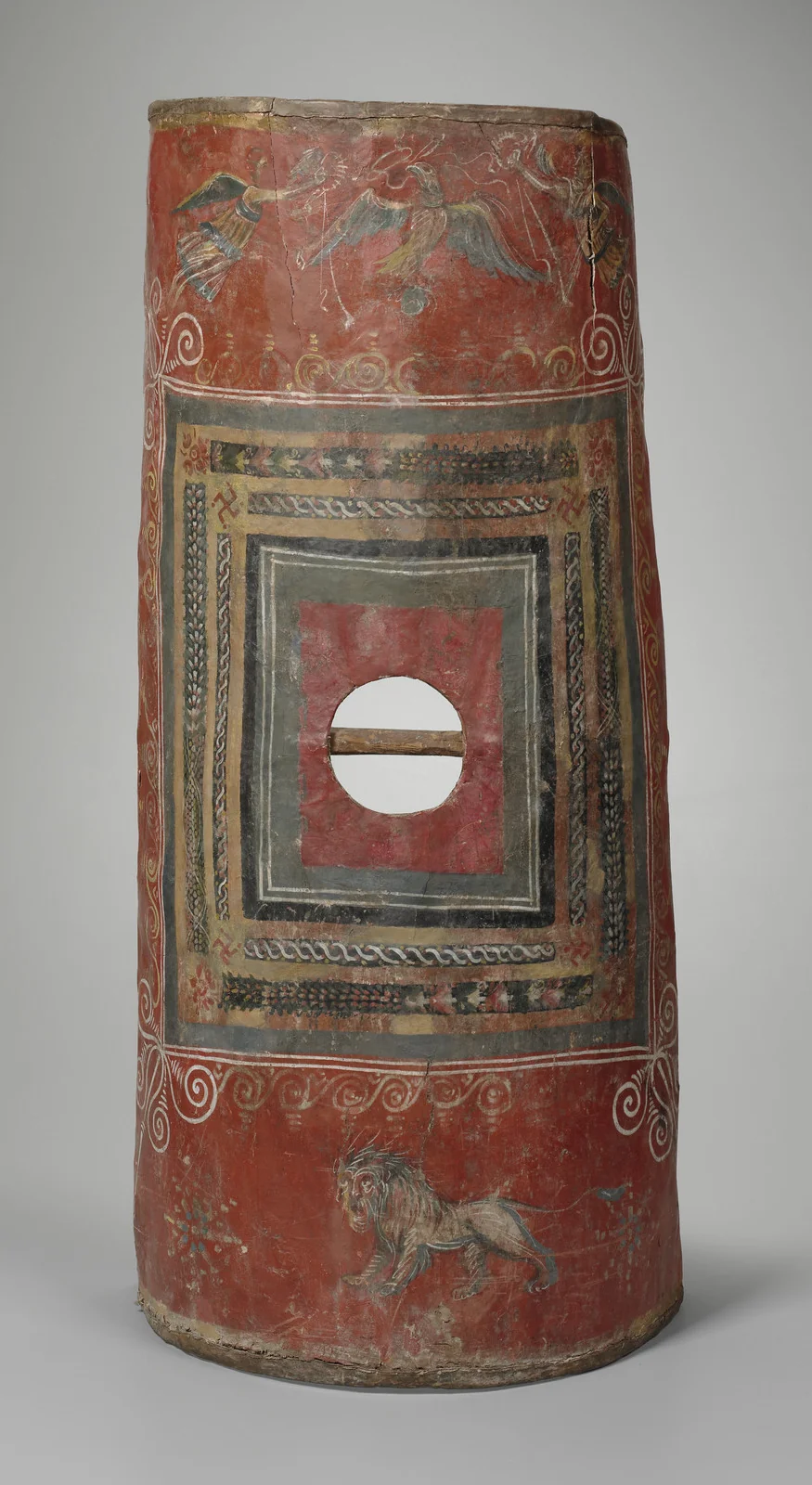
The scutum was the shield that allowed the Roman legion to fight the way it did. Large enough to cover a man from shoulder to knee, curved enough to deflect strikes, sturdy enough to be punched into an enemy's face — and standardized enough that any soldier could replace any other's broken shield with no loss of capability — it was the foundation of every Roman tactical innovation from the late Republic to the early Empire.
Construction
The scutum was made of plywood, in the literal sense. Three thin layers of wood strips, glued together with their grains running at right angles to each other, formed the body of the shield. The whole was faced with leather (sometimes painted canvas) and edged with bronze or iron strips that protected against splitting. At the centre, a hemispherical iron boss — the umbo — covered the soldier's hand and provided structural reinforcement.
The result was light for its size — about 18 to 22 pounds, distributed across the arm. It was also remarkably strong: the cross-grain construction made it difficult to split, and the leather facing absorbed and dispersed impact. Surviving examples, like the well-preserved scutum from Dura-Europos, show construction techniques essentially unchanged from earlier examples a century or two older.
Dimensions and curvature
A standard early-imperial scutum was roughly 40 to 50 inches tall and 24 to 32 inches wide. The curve was significant — the shield was a section of a cylinder, not flat — and it wrapped slightly around the body, deflecting strikes that came in at an angle and protecting more area than its dimensions would suggest. From shoulder to knee was the standard description.
- TypeCurved rectangular shield
- OriginItalic, refined by Rome
- In Servicec. 4th C. BC – 3rd C. AD
- Dimensions~40–50 in tall, 24–32 in wide
- Weight~18–22 lbs
- ConstructionThree-ply wood, leather-faced, bronze or iron edged
- Central FeatureIron boss (umbo) over the grip
- Primary UseClose-formation defense, shield wall, testudo
The umbo and the punch
The iron boss at the centre of the scutum was not just structural. Roman manuals describe using the umbo as an offensive weapon: punching it forward into an enemy's face, chest, or shield to break their stance, knock them backward, or open them up for a gladius thrust to follow. Roman training emphasized this combined defensive-offensive use of the shield as much as it emphasized swordwork.
The testudo
Roman legionaries could lock their scuta together with neighbors' shields to form an almost continuous wall — and lock them overhead to form the famous testudo, the "tortoise" formation. In testudo, a unit could advance under arrow fire, walk up to defended walls, or close on missile-armed opponents who would otherwise have whittled it down. The formation depended absolutely on shields of standard size and shape; a unit equipped with mismatched shields could not form a tight testudo. The scutum's standardization was, in this sense, a tactical capability all by itself.
Decline
By the 3rd century AD, the scutum was giving way. As Roman tactics shifted toward looser, more mobile formations — fighting cavalry-heavy barbarian armies on broad fronts — the heavy rectangular shield became less useful. Smaller oval shields, lighter and more maneuverable, replaced it. By the 4th century, the rectangular scutum was effectively gone. The new shield was descended from auxiliary cavalry shields, not from the legionary scutum, and the connection broke.
Legacy
The scutum is one of the most distinctive symbols of the Roman army — the rectangular curved shield with the central boss, instantly recognizable in every reconstruction of a legionary. It is also a reminder that Roman success was as much about the shape of the shield as about the shape of the sword. The gladius needed the scutum to do its work. Take the shield away, and the close-formation thrust does not work. Roman tactical doctrine and Roman equipment design were inseparable, and the scutum was at the centre of both.