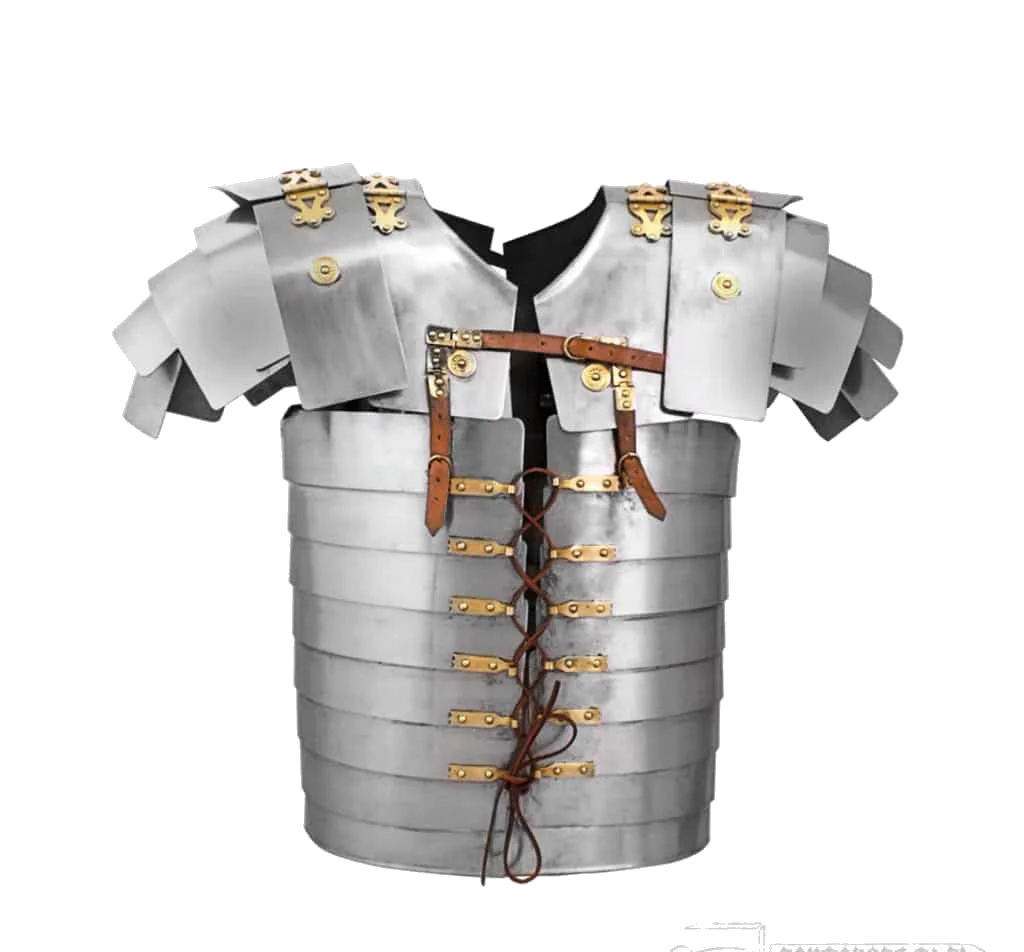
When you picture a Roman soldier, you almost certainly picture lorica segmentata. Bands of curved iron plates wrapping around the torso, with separate shoulder pieces above, joined inside by leather straps — it is the iconic image of the imperial Roman legionary. It is also, slightly unfashionably, an armor that was used for only about two centuries, and probably never as universally as the imagery suggests.
Design and assembly
Segmentata is built from horizontal iron bands, curved to fit the torso, that overlap each other from top to bottom. Vertical leather straps inside the armor joined the bands and allowed them to flex slightly as the wearer moved. Above the torso pieces, separate shoulder protections — multiple curved plates, again strapped together — sat over the shoulders and allowed the arms to move freely. The whole assembly weighed roughly 20 pounds.
Putting it on took some practice but not much time. The armor opened on the front, often with hinges on one side and clasps on the other. A soldier could buckle himself into segmentata in a few minutes, and a comrade could help with the difficult shoulder fittings.
- TypeSegmented plate armor
- OriginRoman
- In Servicec. 1st – 3rd C. AD
- Weight~20 lbs
- ConstructionIron plates joined by leather straps
- CoverageTorso and shoulders
- Primary UseFrontline legionary armor (alongside mail)
Use and lifespan
Segmentata appears in the archaeological record from the early 1st century AD and persists through the early 3rd century. That is roughly two hundred years — substantial, but much shorter than the lifespans of the gladius (six centuries), the scutum (five), or mail (eight or more). And during those two hundred years, segmentata coexisted with mail. Surviving fittings, depictions on Trajan's Column, and the body of archaeological evidence suggest that some legions wore segmentata more than others, that mail remained common throughout the period, and that the iconic image of every legionary in segmentata is partly a modern simplification.
Maintenance
Segmentata's main weakness was maintenance. The leather straps wore out fast — sweat, sun, abrasion against the metal — and required regular replacement. The fittings (hinges, buckles, hooks) broke under stress. The iron plates rusted unless kept oiled. A legion equipped with segmentata depended on a constant flow of replacement parts and skilled armorers to keep the kit serviceable.
The Corbridge Hoard
Our best window into all this is the Corbridge Hoard, a remarkable cache of segmentata fittings buried in northern Britain in the late 2nd century AD. The hoard contained fragments of multiple sets of armor along with spare hinges, buckles, hooks, and broken pieces awaiting repair — essentially, an army workshop's stock of consumables. Studying the Corbridge fittings transformed historians' understanding of how segmentata actually worked, how it was assembled, and how often it broke.
Why it disappeared
By the late 3rd century, segmentata seems to have stopped being worth the trouble. Cheaper, easier-to-maintain alternatives — particularly mail and scale armor — could be produced and serviced more reliably. The army was also restructuring under Diocletian, with heavier reliance on cavalry and looser infantry formations that favored simpler, lighter armor. Whatever the precise reasons, segmentata vanishes from the archaeological record in the early 4th century. Its iconic visual legacy outlasted its actual military service by many centuries.