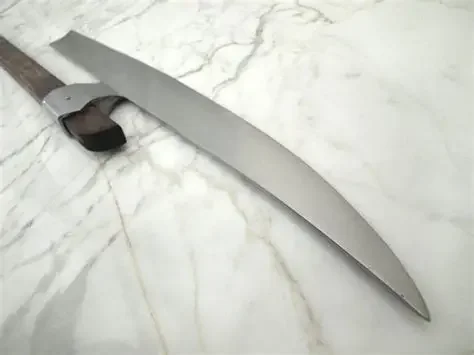
The atgeir is the saga-weapon — the polearm that appears repeatedly in Norse literature, wielded by heroes, and whose exact form is still debated among modern scholars. Translated variously as "halberd," "bill," "glaive," or simply "long-spear," the atgeir was clearly something more than an ordinary spear: a hafted weapon with a composite head capable of both thrusting and cutting, and culturally marked as the weapon of the exceptional warrior.
In the sagas
The atgeir's literary reputation runs ahead of its archaeological one. Gunnar Hámundarson, the hero of Njál's Saga, fights almost exclusively with an atgeir, and his weapon is said to "sing" before battle — a high ringing tone that the saga treats as an omen of impending death, either his or his enemies'. In Egil's Saga, Egil Skallagrímsson kills the berserker Atli the Short with an atgeir thrust. In several other sagas, atgeir-wielders are described as performing feats that would be implausible with a standard spear: cutting a man down with a sweeping stroke, or sweeping the legs from under a charging opponent.
The atgeir is almost always associated with named warriors and dramatic moments. The saga authors clearly knew the weapon as something prestigious and recognisable to their audience — a polearm with a specific character, not a generic spear. Whether the saga descriptions are realistic or romanticised is harder to say, but the cultural category clearly existed.
What it actually was
The archaeological problem is that no surviving Viking-age weapon is unambiguously labelled "atgeir." There are oversized spearheads in the record — some with secondary cutting edges along the lower blade, some with broader leaf shapes, some with wings or hooks below the head — but none with a label or inscription identifying it as the saga weapon. Reconstruction depends on a careful reading of the saga texts against the surviving polearm heads that look like they could plausibly belong to the same family.
The Old Norse word atgeirr breaks down as at-geir, where geir means "spear" and at- has been read as either "at, against, towards" (suggesting a thrust-spear) or as a general intensifier (suggesting a special or elaborate spear). Both readings give a weapon that is essentially a spear but specialised.
- TypeTwo-handed polearm with composite head
- OriginNorse (saga-attested)
- In Servicec. 9th – 11th C. AD
- Haft Length~200–220 cm
- HeadLong thrust blade with secondary cutting edges or hook
- Weight~1.5–2.5 kg
- MaterialIron head, ash or hardwood haft
- Primary UseTwo-handed polearm combat; elite/hero weapon
The best modern reconstructions converge on the following: a polearm with a haft of around 200 to 220 centimetres, topped with a long thrusting blade (perhaps 30 to 40 centimetres) that broadens at the base into secondary cutting edges or a hook. The whole resembles a primitive form of the later medieval glaive or guisarme. It is used two-handed, like the Dane axe, with the shield set aside.
How it fought
An atgeir wielded two-handed could deliver a long thrust at greater reach than any sword or hand-axe could match. The same head, swung in a sweeping cut, could deliver an edge-blow that no ordinary spear could. The hook or secondary edge could catch a shield rim and pull it down, or sweep a leg from under an advancing opponent. The atgeir's reputation for versatility in saga is, in this reading, accurate: it is the Viking weapon that does what later polearms would do — combine thrust, cut, and hook in one head.
Used in formation, the atgeir would have functioned as an extended-reach second-rank weapon, the wielder striking past the front rank of spears and shields. Used in single combat, it gave its owner roughly twice the reach of a sword-and-shield opponent and the option to cut as well as thrust.
The singing atgeir
The "singing" atgeir of the sagas — Gunnar's especially — is sometimes dismissed as poetic fancy, but the phenomenon may have a real basis. A thin metal blade under tension can produce an audible ringing tone when struck, brushed, or even vibrated by wind passing over its edge. A well-made composite head with an attached hook or wing could, plausibly, sing in certain conditions. Whether it sang prophetically — as Gunnar's saga claims — is, of course, another question entirely.
Legacy
The atgeir as a named Norse weapon does not survive the Viking Age. Its functional descendants — the medieval bill, glaive, and halberd — emerge in continental Europe and Britain over the following centuries, and they show the same broad logic: a thrust point, a cut edge, a hook. Whether these descend directly from the atgeir, or whether they reinvented the same solution independently, is impossible to say. But the design principle that the sagas record was correct, and it was the design principle that shaped European infantry weapons for the next five hundred years.