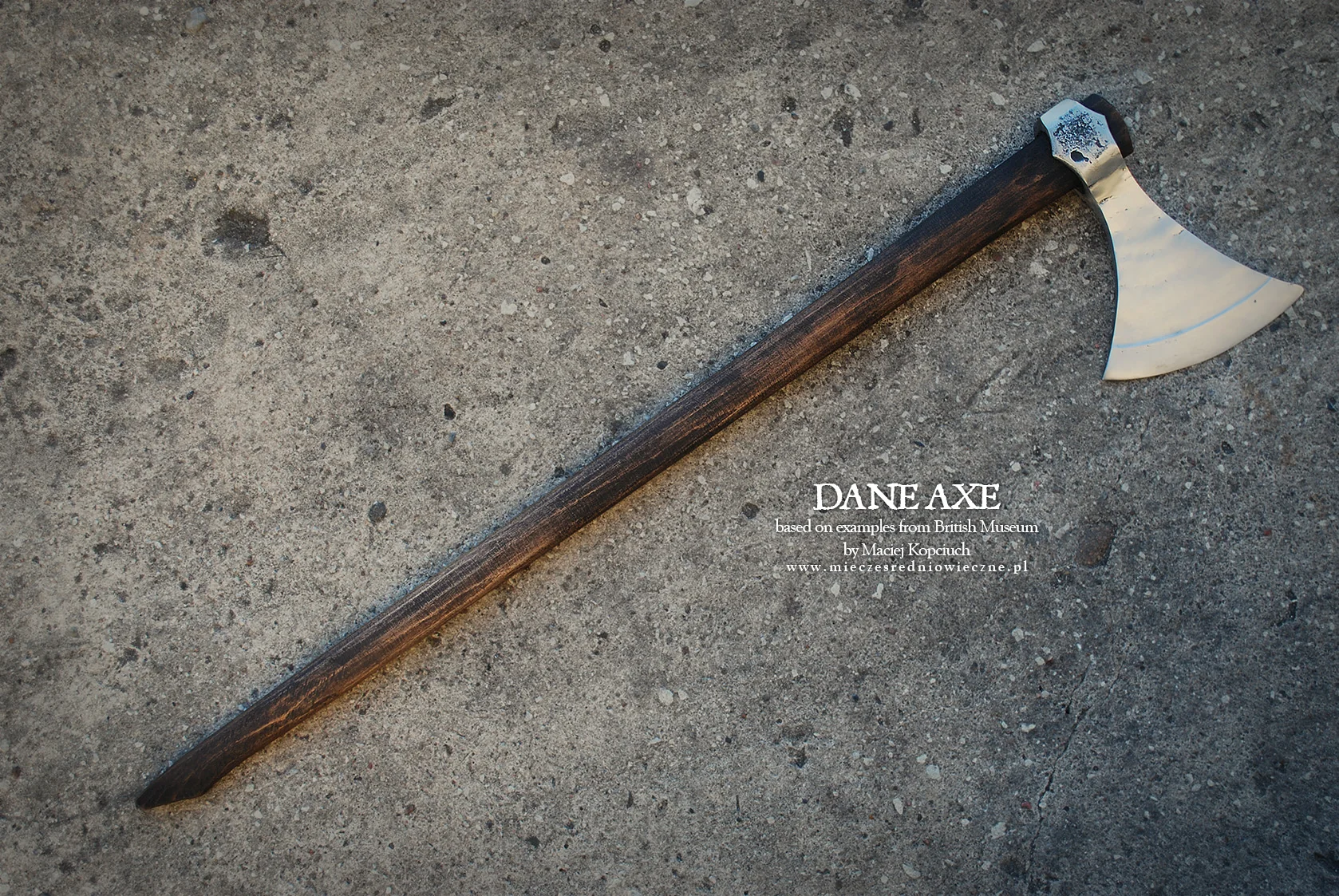
The Dane axe is the great two-handed war axe of the late Viking Age — a long-hafted, broad-bladed weapon designed for a single specialised purpose: cleaving through shields, mail, and the men inside them. It is the weapon that the Anglo-Saxons named after the Danes who carried it, and the weapon that the Varangian Guard at Constantinople carried for two centuries after the Viking Age itself was over.
A specialist's weapon
The Dane axe was not the cheap, ubiquitous tool that the Viking hand axe was. It was a deliberate two-handed war weapon, owned and trained with by professional warriors. The haft was long — typically 120 to 150 centimetres, sometimes more — and the head was forged broad and thin, with a sweeping cutting edge that could reach 25 to 30 centimetres along its curve. The poll behind the edge was reinforced, but the cutting blade itself was sometimes only millimetres thick at the edge. The whole weapon weighed less than its appearance suggested — typically 1 to 2 kilograms — because the thinness of the blade kept the mass concentrated near the cutting line.
Wielding it required two hands, which meant abandoning the shield. A warrior carrying a Dane axe trusted his footwork, his armour, and the men around him to keep him alive long enough to deliver his blows. He was paid — in coin, in land, in feast-time honour — to be the man who broke the other line.
- TypeTwo-handed war axe
- OriginNorse (Denmark / Scandinavia)
- In Servicec. 10th – 12th C. AD
- Haft Length120–150 cm
- Cutting Edge22–30 cm
- Weight1.0–2.0 kg
- MaterialForged iron head, hardwood haft (ash or hickory)
- Primary UseTwo-handed melee; shield- and mail-breaking
What it did
A Dane axe could do things no one-handed weapon could. A two-handed swing with a 140-centimetre haft delivers enormous energy at the cutting edge — enough to shear through a wooden shield, snap a mail haubergeon, or take a leg off below the knee. The reach is also formidable: a Dane axe extended at full swing covers more than 2 metres of arc.
Against cavalry, the Dane axe was especially feared. The Bayeux Tapestry — the great visual record of the Battle of Hastings in 1066 — shows huscarls of Harold's army wielding Dane axes against Norman cavalry. One panel depicts a huscarl bringing down both horse and rider with a single overhand blow. This is not artistic licence: a Dane axe descending with two-handed force could do exactly that.
Anglo-Saxon adoption
Long before Hastings, the Anglo-Saxons had adopted the Dane axe wholesale. The huscarls — the elite household troops of the late Anglo-Saxon kings — were essentially a Norse military institution operating in an English army. They carried Dane axes, wore mail, and fought in dense formation. At Hastings they formed the centre of Harold's shield wall, and although the line eventually broke, the huscarls fought with their axes to the last. The axe-wielding Anglo-Saxon huscarl is one of the iconic images of 1066.
The Varangian Guard
After the Viking Age proper had ended in the West, the Dane axe travelled east. The Varangian Guard — the personal bodyguard of the Byzantine emperor, recruited from Norse and Anglo-Saxon mercenaries from the 10th century onwards — carried Dane axes as their characteristic weapon. Byzantine writers referred to them as the pelekyphoroi, "the axe-bearers." For nearly three centuries, the most prestigious military formation in the eastern Mediterranean was a Norse axe-line standing in the imperial palace of Constantinople. The Varangians outlived the Viking Age by 150 years, and they carried Dane axes the whole time.
Decline
The Dane axe disappeared from European battlefields during the 12th and 13th centuries — pushed out by the rise of mounted knighthood, the polearm-and-pike infantry of the high Middle Ages, and the increasing dominance of plate armour, against which a thin-bladed cutting axe was less effective than it had been against mail. The two-handed war axe survived in modified form into the late medieval period, but its golden age was the century either side of 1000 AD, when a man with a long axe and the will to swing it could break almost any line he was sent against.