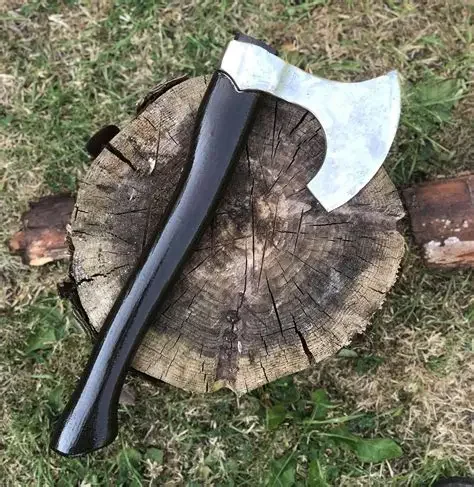
The bearded axe — skeggöx in Old Norse, "beard-axe" — is the iconic one-handed Norse war axe. The "beard" is the elongated lower portion of the cutting edge that hangs down past the socket where the head meets the haft, giving the blade a distinctive hooked profile. The shape was not aesthetic; it solved several problems at once.
The shape and what it does
A bearded axe head is asymmetric. The upper edge is short — perhaps 4 or 5 centimetres above the socket. The lower edge is long — 10 to 15 centimetres of curve extending below it. The result is a long total cutting edge for a relatively light head, mounted on a short one-handed haft.
The beard does three things. First, it extends the cutting surface without adding weight — most of the blade's mass stays close to the haft, which keeps the axe fast and balanced. Second, the hook of the beard can catch the rim of an opponent's shield and pull it down, opening a line of attack for the next blow or for a comrade beside you. Third, the same hook can catch a limb, an ankle, or the back of a horse's leg. A bearded axe is a grappling tool as well as a cutting one.
Construction and ubiquity
Most bearded axes are utilitarian. A forged iron head — sometimes with a hardened steel edge welded along the cutting line — mounted on a haft of 60 to 90 centimetres of ash, hickory, or birch. The poll behind the edge is usually thin, not intended for hammering. The eye is tapered so the head is friction-fit onto the haft and held in place by wedges. A skilled blacksmith could produce one in a long afternoon. Every market town across the Viking world produced them in quantity.
- TypeOne-handed bearded war axe
- OriginNorse (skeggöx)
- In Servicec. 8th – 11th C. AD
- Haft Length60–90 cm
- Cutting Edge10–20 cm (with long lower beard)
- Weight0.5–1.2 kg
- MaterialForged iron head, hardwood haft
- Primary UseOne-handed melee paired with shield
The bearded axe is the most common identifiably-Norse weapon in the archaeological record. It appears in nearly every Viking-age grave that contains weapons — usually paired with a spear, sometimes with a shield boss, occasionally with a sword. The axe was the weapon a man owned all his life. The sword was the weapon his grandfather had owned, if anyone in the family had ever owned one.
The Mammen Axe
The most famous decorated example is the Mammen Axe, recovered from a chieftain's grave at Mammen in Denmark and dated to around 970 AD. Its iron head is inlaid with silver wire in a complex interwoven design that has been the subject of decades of scholarly debate. One face shows what most scholars identify as a stylised Tree of Life — a Christian motif. The other shows a bird that has been read as Odin's raven, Hugin or Munin — a pagan motif. The Mammen Axe was made at the cusp of Denmark's conversion to Christianity, and its owner seems to have hedged his bets: a single object carrying both old and new symbols. Whatever was in his head when he commissioned it, the axe is now the single most evocative artefact of the religious transition of late-Viking Scandinavia.
One-handed combat
In the shield wall, the bearded axe was a one-handed weapon paired with a round shield. The wielder fought close, using the shield to defend and the axe to strike, hook, and pull. The relatively short haft suited the cramped fighting that happened when two shield walls collided — there was no room for a long axe swing, but plenty of room for short chopping motions and grappling hooks at chest, arm, and thigh.
Outside formation, the bearded axe was equally at home — a man on a doorstep, a raider in a longhouse, a sailor on a shipboard fight. It was the Viking weapon for every situation that was not either a heavy formation engagement or a single-combat duel.
After the Vikings
The bearded axe outlived the Viking Age. Variants persisted in Scandinavia, Russia, and the Baltic into the high Middle Ages, and the form influenced the development of various medieval one-handed war axes across Europe. The modern recreations sold for outdoor and woodcraft use today descend more or less directly from the skeggöx. It is one of the few weapon forms that the Vikings invented, refined, and bequeathed essentially unchanged to the modern world.