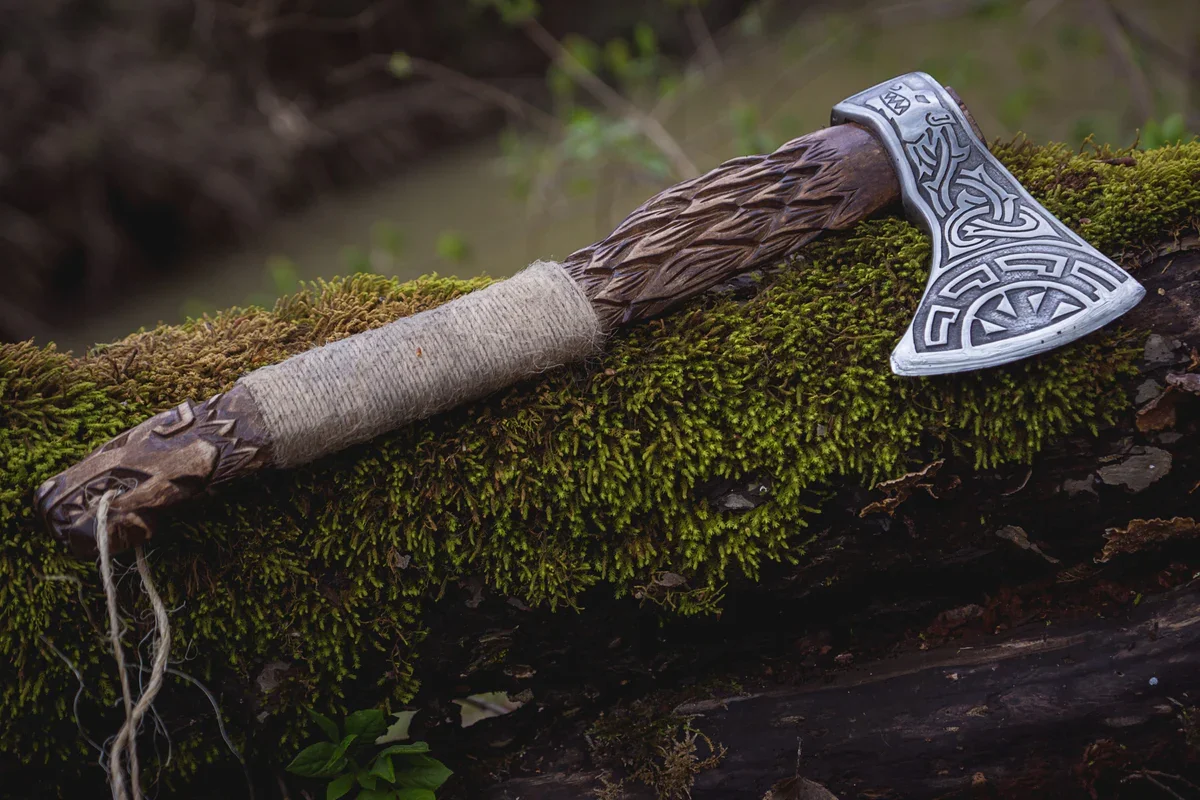
The hand axe is the most ubiquitous weapon of the Viking Age and arguably the least studied, precisely because it is so common. Every farmer owned one. Every Viking ship sailed with a dozen of them aboard for shipboard work and shore defence. Every Viking-age grave that contains any iron at all contains a hand axe. The image of the Viking we have — the sword, the mail, the elaborate helmet — describes the wealthy elite. The reality, for the great majority of Norsemen, was the spear and the hand axe.
Tool first
The hand axe is a tool first and a weapon second. It is what a Norse household used to split firewood, hew planks, prepare meat, butcher livestock, build shelter, and do the thousand small tasks of a self-sufficient farm. The axe was kept by the door, hung at the belt for outdoor work, and carried aboard ship for repair work and rope cutting. A Norseman would have spent thousands of hours with his axe in his hand for every minute he spent using it as a weapon — and that work shows in the wear patterns on surviving examples, where the cutting edges are reground and the polls are dented from hammer-use against wood.
Construction is minimal. A small forged-iron head — 8 to 15 centimetres along the cutting edge, weighing 400 to 800 grams — wedge-fitted to a short hardwood haft of 40 to 60 centimetres. Most examples are plain iron with a slightly harder steel edge welded along the bite. No decoration, no elaborate forging, no fittings. Just iron that holds an edge well enough to do the work.
- TypeOne-handed utility and war axe
- OriginUniversal Norse
- In Servicec. 5th – 12th C. AD
- Haft Length40–60 cm
- Cutting Edge8–15 cm
- Weight0.4–0.8 kg
- MaterialForged iron, hardwood haft
- Primary UseTool, melee, and thrown weapon
Weapon when needed
But when a fight came, the hand axe was the weapon a man already had in his hand. There is no need to draw it from a sheath. There is no need to train extensively in its use — anyone who has split firewood since childhood knows how to swing one. And in close combat, a sharp axe is a devastating weapon at less than two metres' range, the distance at which most early-medieval fighting actually happened.
The hand axe was used in three modes. As a one-handed melee weapon, it struck cutting blows and could hook with the lower edge in the manner of the bearded axe (though less effectively, since the hand axe usually lacks the pronounced beard). As a thrown weapon, it could be hurled with surprising accuracy at ranges of 5 to 10 metres — a Norse-age throwing technique that survived into folk tradition and is still preserved by some living crafts. As a finishing tool in cramped quarters — the doorway of a longhouse, the deck of a captured ship — it was deadlier than longer weapons that could not be swung freely.
In the shield wall
The shield wall was a long-weapon affair: spears at the front, axes and swords in the second rank, polearms behind. The hand axe came into its own when the wall broke. Once formations dissolved into individual fighting, the man with the long Dane axe was suddenly overcommitted — his two-handed swings too slow, his reach too long for the press. The man with the spear had no spear left, broken in the first exchange or buried in another man's shield. What both still had on their belts was a hand axe.
The end of every Viking-age battle was a hand-axe fight.
In the record
The hand axe's archaeological prevalence makes the point clearly. In Viking-age cemeteries across Scandinavia, the British Isles, Iceland, and the eastern trade routes, the hand axe is the single most commonly recovered weapon. Spears come second. Swords are rare. Shields rarer. Mail rarer still. The story the graves tell is the opposite of the Hollywood story: the Viking was a man with an axe and a spear, sometimes a shield, occasionally a helmet, and almost never a sword.
Legacy
The hand axe never really left. It is the direct ancestor of the standard European wood-axe in continuous use since the early Middle Ages, and the lineal forerunner of the modern carpenter's hatchet, hunter's belt axe, and bushcraft tool. Every modern hardware store sells the descendant of the Viking hand axe. The form was so well solved by 800 AD that twelve centuries of refinement have changed it only marginally.