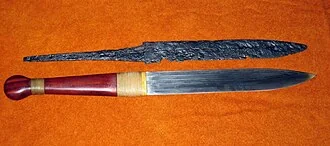
The seax — sometimes spelled sax, sæx, or scramasax — is the single-edged blade of the Germanic world. Anglo-Saxons, Franks, Frisians, and Norse all carried versions of it for six hundred years across the early Middle Ages. The Saxons take their name from the weapon: in Latin, sahsō meant the blade and, by extension, the people who carried it. By the Viking Age, the seax was already centuries old, but it was still the most commonly carried blade in northern Europe — every farmer had one, every warrior carried at least one alongside whatever larger weapon he could afford.
A weapon and a tool
The seax is fundamentally a working knife scaled up to fighting size when required. The blade is single-edged, with a thick blunt spine that provides structural strength and a long, sometimes slightly curved, cutting edge. There is no crossguard or only a minimal one — the seax is held more like a chef's knife than a sword. The hilt is a simple wooden, bone, or antler grip riveted onto the tang.
Surviving examples span a huge size range. The smallest are belt knives barely 15 to 20 centimetres long, indistinguishable from utility tools. The largest — the langseax — reach 70 to 80 centimetres and are short swords in everything but name. Between these extremes sit the everyday fighting seaxes: 40 to 60 centimetres in length, light enough to wear at the belt all day, sharp enough to kill if needed.
The seax was worn horizontally across the small of the back or angled at the belt, in a tooled leather sheath that was sometimes more decorated than the blade itself. Drawing the seax was a deliberate cross-body motion — slower than drawing a sword, but more discreet, and possible from a seated or constrained position.
The broken back
Late Viking-Age seaxes — particularly in England and the Danelaw — often display a distinctive "broken-back" profile, where the straight spine angles sharply downward near the tip, producing a clipped, almost cleaver-like point. The form gives a much stronger point for thrusting while preserving the long cutting edge along the belly of the blade. The Beagnoth Seax, recovered from the Thames and dating to the 9th or 10th century, is the most famous example. It carries the only complete Anglo-Saxon futhorc runic inscription known on a weapon, running the length of the blade-back.
- TypeSingle-edged knife / short sword
- OriginGermanic / Migration Period
- In Servicec. 5th – 11th C. AD
- Total Length25–80 cm (varied)
- Blade Length15–70 cm
- Weight0.3–1.2 kg
- Blade MaterialForged iron with steeled edge
- Primary UseUtility tool and sidearm
In Norse use
For the Vikings specifically, the seax filled two roles. The small seax was a daily utility knife — the Norse equivalent of the modern multi-tool. Every adult carried one. It was used at meals, in the workshop, on board ship, in the field. It was the first thing a man reached for and the last thing he set down.
The larger seax was a fighter's sidearm. A warrior who could afford only one significant weapon often carried a langseax instead of a sword — it cost a fraction as much, did much of the same work in close combat, and was less embarrassing to be seen with than no blade at all. A warrior who owned a sword usually also owned a seax for the same reasons a modern soldier carries a pistol alongside his rifle: when the primary weapon fails or is lost, the sidearm is what you have.
After the Vikings
The seax outlasted the Viking Age but was already in decline by 1100. The reasons are mundane. The economy of medieval Europe was producing more swords for fewer warriors, and the role of the long single-edged blade was being absorbed by the falchion and, much later, by the late-medieval messer. By the 13th century, the seax as a recognized form of blade was effectively gone. Its descendants are the working knives and bushcraft blades of the modern North — the seax never really died, it just stopped being called one.