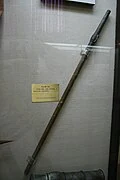
The huochong — literally "fire spout" — is the weapon that begins the modern era of military history. Every musket, rifle, pistol, machine gun, artillery piece, and tank gun in the world today traces its ancestry, through a chain of incremental improvements, back to a small bronze tube produced somewhere in late-13th-century China. The oldest surviving firearm in the world is a Chinese huochong, dated to 1288, recovered from Heilongjiang province in 1970. Everything that came after — the European hand cannon, the Ottoman musket, the matchlock arquebus, the modern assault rifle — is a refinement of the principle established in that one bronze tube.
The first firearm
The huochong is the end of a long Chinese line of gunpowder development. Gunpowder itself was discovered in China in the 9th century by Daoist alchemists looking, with characteristic optimism, for an elixir of immortality. The first military applications were incendiary — fire arrows, incendiary bombs, smoke generators. By the late 10th and early 11th century, Chinese armies were using primitive flamethrowers and bombs containing explosive gunpowder mixtures. The Wujing Zongyao of 1044 records several gunpowder weapons, but none are firearms — none use the contained explosion of gunpowder to propel a projectile out of a barrel.
That step took another two centuries. The earliest "fire lance" weapons, appearing in the Southern Song and Jin dynasties around 1130–1230, used short bamboo or paper tubes packed with gunpowder and small projectiles, attached to the end of a spear. They sprayed flame and shrapnel for a few feet — terrifying at close range, but not weapons in the modern sense. By the late 13th century, under the Yuan dynasty, the tubes had become metal, the gunpowder mixtures more refined, and the projectiles more substantial. The first real hand cannons appear in archaeology and in texts at almost exactly this moment.
- TypeBronze or iron hand cannon
- OriginLate Yuan / early Ming China
- In Servicec. late 13th C. – 16th C. AD
- Length~15–30 cm (handheld); up to 1 m (larger forms)
- Weight~3–8 lb (handheld)
- ProjectileLead ball, stone, or metal scrap
- Effective Range~20–30 m
- Primary UseAnti-armor close-range infantry; siege defense
Design
A typical huochong is a bronze or iron tube, fifteen to thirty centimeters long, with thick walls to contain the explosion of black powder. The breech end is closed; a small touch-hole in the side allows a slow-burning fuse or match to ignite the powder charge. The muzzle is open. Inside, a measured charge of gunpowder is placed at the back, packed against the closed breech, and a projectile — a lead ball, a stone, or a handful of metal scrap — is rammed in on top.
To fire, the gunner braces the cannon against his body or shoulder, points it at the target, and applies a match or coal to the touch-hole. The powder ignites, expanding gases drive the projectile out the muzzle. Smoke, recoil, noise. Repeat.
By modern standards the huochong is a terrible firearm. It is heavy, slow to load, inaccurate, and lethal mostly within twenty or thirty meters. But it had one decisive property: at close range, it could punch a hole through any armor in existence at the time. Mail, lamellar, plate — none of it could resist a half-ounce lead ball traveling at the velocities a black-powder charge could impart over even a short barrel. The huochong made armor irrelevant.
The diffusion of gunpowder weapons
The huochong moved across Eurasia faster than any other Chinese invention. Within a generation of its first appearance in the late 13th century, hand cannons were being produced in the Middle East and the Mongol khanates. By the early 14th century they were in Europe — the Battle of Crécy in 1346 included primitive European hand cannons, almost certainly developed from designs transmitted along the Silk Road and through the Mongol military networks. The Ottomans adopted them by the late 14th century. By 1450 every major military power in Eurasia was producing some version of the hand cannon.
The Ming dynasty in particular embraced the huochong, organizing dedicated gunpowder-weapon units (shen ji ying, "divine machine battalions") and producing hand cannons in the tens of thousands. Ming forces used them extensively against Mongol cavalry, against southern rebel armies, and against the Japanese during the Imjin War in Korea in the 1590s.
Legacy
Every firearm that has ever been made is a descendant of the huochong. The matchlock arquebus, the flintlock musket, the percussion rifle, the breech-loading repeater, the bolt-action service rifle, the assault rifle, the modern combat handgun — every one of them works by the same principle the huochong established: a contained chemical explosion drives a projectile down a barrel and toward a target.
The Chinese invented this. They did not, ultimately, sustain the technological lead. By the 17th and 18th centuries European gunmakers had outpaced Chinese production both in volume and in refinement, and the firearms that eventually marched up the Pearl River with the British in 1840 were superior, by every reasonable measure, to anything Chinese armies were producing. But the principle, the breakthrough, the founding act — that belongs to a Chinese gunner in the Yuan dynasty, lighting a match to a hole in a piece of bronze.