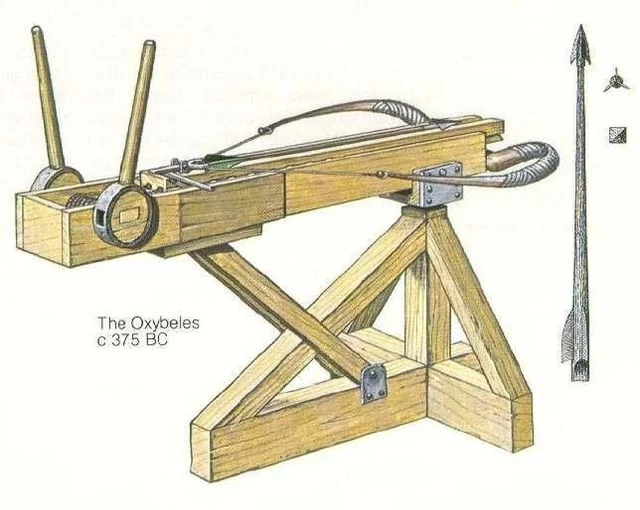
Where the gastraphetes used a flexed composite bow, the oxybeles used twisted sinew. That single change — from bending wood to twisting fiber — is the origin of all torsion artillery in the ancient world. Two horizontal arms, each anchored in a tightly wound bundle of sinew, drew a bowstring against energy that a flexed bow could not match. The oxybeles threw a heavier bolt further, and faster, than the gastraphetes ever could. It was the bridge between the proto-crossbow and the Roman ballista.
Origins
The torsion principle was a Macedonian invention, developed under the engineering corps assembled by Philip II in the mid-4th century BC and refined under Alexander. Philip's military reforms had already produced the sarissa-armed phalanx; the oxybeles was the artillery counterpart, designed to support sieges and tactical operations the heavy infantry could not handle alone.
The breakthrough was the realization that twisted bundles of organic fiber — sinew from animal tendons, or sometimes human hair — could store far more rotational energy than any composite bow could store as bending tension. A pair of horizontally-mounted torsion bundles, each with one end of an arm anchored in it, could be drawn back against torques that no human-scale bow could approach.
Design
An oxybeles consisted of a wooden frame holding two vertical torsion bundles, with horizontal arms projecting forward from each. A bowstring connected the tips of the two arms. To fire, the operator winched the string back along a slider running through the frame, latched it into a trigger mechanism, loaded a bolt onto the slider, and released the latch.
The arms snapped forward, the string flung the bolt down the slider, and the projectile left the weapon at speeds comparable to a modern arrow. Range could exceed 300 yards for the smaller versions, and the bolts — iron-tipped wooden shafts about 18 to 24 inches long — could drive through shield, armor, and the man behind both.
- TypeTwo-armed torsion bolt-thrower
- OriginMacedonian, 4th C. BC
- In Servicec. 4th – 3rd C. BC
- Power SourceTwisted sinew or hair torsion bundles
- Range~300 yards (smaller versions); larger types farther
- ProjectileIron-tipped bolt, ~18–24 in
- Primary UseSiege warfare and tactical fire support
Use under Alexander
Alexander made extensive use of oxybeles in his sieges. At Tyre in 332 BC — one of the most famous sieges in ancient history — oxybeles were mounted on the moles his engineers built across the harbor and on the floating siege platforms that carried his men toward the walls. They cleared defenders off battlements, broke up missile crews, and provided covering fire while battering rams and assault ladders did the close work.
Outside of formal siege contexts, Alexander also used oxybeles for tactical fire support — engaging enemy positions at ranges his infantry could not reach with javelins or hand-bows. This was the beginning of artillery as an integrated combat arm rather than as a specialized siege tool, an insight the Romans would later develop further with their own scorpiones.
Hellenistic refinement
After Alexander, oxybeles continued in service throughout the successor kingdoms. Alexandrian engineers in Ptolemaic Egypt produced detailed treatises on torsion artillery, working out optimal proportions, trigger mechanisms, and arm geometries. Hellenistic city-states routinely included oxybeles in their walls and mobile siege trains.
By the 3rd century BC, the basic design had stabilized. Variations in size produced weapons ranging from light field pieces operable by two men to large fixed-emplacement bolt-throwers with multi-man crews. The Hellenistic period was, in many ways, the high point of pre-Roman torsion artillery.
Roman inheritance
When Rome encountered Hellenistic armies during the Punic Wars and the wars against Macedon, Roman engineers studied the artillery and adopted it. The Roman scorpio is essentially a slightly-refined Greek oxybeles. The technical vocabulary in Latin treatises is full of Greek loanwords. The mechanism, the proportions, the construction technique — all were inherited rather than independently invented.
What Rome added was scale. Where Hellenistic kingdoms used artillery in specialized contexts, Rome integrated it into the regular legion at the level of every century. By the early Empire, every legion deployed dozens of scorpiones in addition to its infantry. The original Greek oxybeles design, in this sense, ended up doing the work of empire.
Legacy
The oxybeles is the ancestor of every torsion artillery weapon up to the medieval period. Its direct descendants — the carroballista, the scorpio, the Byzantine cheiromangana — carried the form through the Roman Empire and into the early medieval world. Only the development of the trebuchet (using counterweight rather than torsion) in the 12th century AD finally displaced the basic oxybeles concept, ending a tradition that had begun fifteen hundred years earlier in Macedonian engineering workshops.